
🔑 Key Takeaway
Key Clinical & Policy Sources
- According to SAMHSA’s 2022 National Survey, approximately 22.8% of U.S. adults experienced mental illness in the past year.
- SAMHSA data shows only 46.2% of U.S. adults with mental illness received treatment in 2022.
- The CDC reports depression affects more than 21 million American adults annually.
Residents of New York seeking Medicaid personal care aide Bronx can access Medicaid-covered telehealth mental health services in 2026. Our clinical team is available to help navigate enrollment, provider selection, and ongoing care coordination.
Medicaid Personal Care Aide in the Bronx: A First-Timer’s Real Guide to Getting Help at Home
Finding out you need help at home, or realizing your parent does, is rarely a single moment. It is usually a slow accumulation of small worries: medication left untouched, groceries that did not get picked up, or a bath that has become a fall risk. If you are a Bronx resident trying to understand what Medicaid actually covers and whether a personal care aide may be available, this guide explains the process in plain language.
What Does a Medicaid Personal Care Aide Actually Do?
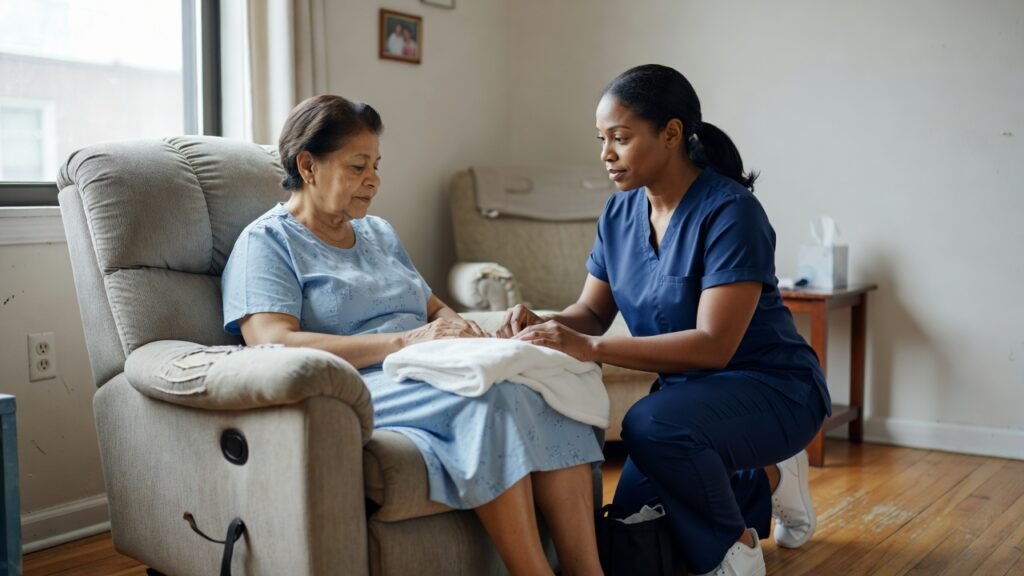
A Medicaid personal care aide (PCA) helps an eligible person with authorized activities of daily living and other personal care needs.
Depending on the person’s approved plan of care, services can include:
- Bathing
- Grooming
- Dressing
- Toileting
- Assistance with mobility and ambulation
- Meal preparation
- Light housekeeping related to the person’s care
- Other authorized personal care activities
New York’s Personal Care Services program specifically includes services such as housekeeping, meal preparation, bathing, toileting, and grooming.
A PCA is not a substitute for every type of medical professional. Skilled nursing, certain therapies, wound care, injections, and other clinical services may fall under different Medicaid benefits and require separate authorization.
That distinction matters because families should know what a PCA is authorized to do before services begin.
Who Can Qualify for a Medicaid Personal Care Aide in the Bronx?
There are two separate questions:
- Does the person qualify for Medicaid?
- Does the person meet the requirements for Medicaid personal care services?
Having Medicaid does not automatically mean a person qualifies for personal care services.
For adults subject to the current rules, New York implemented new Minimum Needs Requirements on September 1, 2025. For PCS/CDPAP, an individual generally must be assessed as needing at least limited assistance with physical maneuvering with more than two Activities of Daily Living (ADLs).
For an individual with Alzheimer’s disease or dementia, the applicable standard is at least supervision with more than one ADL.
This is an important correction to older articles that say needing help with only one ADL is enough for a new adult applicant. That is no longer the general standard for people subject to the Minimum Needs Requirements.
There are exceptions. For example, the Minimum Needs Requirements do not apply to certain people who were already authorized for or receiving PCS/CDPAS, or continuously enrolled in an MLTC plan, as of September 1, 2025. PACE enrollment is also treated differently under the current rules.
What About Medicaid Income and Asset Limits?
This is another area where older online articles can be misleading.
The original version of this article used a $1,732 monthly income figure and 2024–2025 resource limits. Those numbers should not be presented as universal 2026 Medicaid limits.
New York Medicaid eligibility depends on the applicant’s eligibility category, age, disability status, household circumstances, income, resources, and applicable deductions or protections.
Some people who initially believe they are over the limit may still have a Medicaid eligibility pathway.
For that reason, do not automatically rule yourself or a parent out because of a monthly income number found in an older article.
If you are unsure, verify the current rules with NYC HRA or the New York Medicaid Helpline.
How Do You Apply for Medicaid in the Bronx?
For many Bronx residents, NYC Human Resources Administration (HRA) is the starting point for Medicaid eligibility.
You can use ACCESS HRA to manage an HRA case, check case information, view notices, and submit requested documents.
For current assistance:
NYC HRA / DSS OneNumber: 718-557-1399
NY Medicaid Helpline: 1-888-692-6116
Because HRA office locations, hours, and procedures can change, confirm the current information before visiting an office rather than relying on an old article’s office list.
What Happens After Medicaid Is Established?
The next step depends on the person’s circumstances and the type of services being requested.
For adults seeking PCS/CDPAP, the current process includes an assessment through the New York Independent Assessor Program (NYIAP) for applicable individuals. NYSDOH states that adults must have a community health assessment and clinical appointment completed through NYIAP to determine whether they are eligible for PCS.
The assessment looks at the person’s actual functional needs.
That means families should be prepared to explain:
- What activities the person cannot perform independently
- How much assistance is needed
- Whether mobility is limited
- Whether there are cognitive or safety concerns
- What informal help is already available
- How the person’s condition affects daily life
Do not minimize the person’s difficulties during an assessment.
At the same time, do not exaggerate them.
The goal is to provide an accurate picture of what the person can and cannot safely do.
What Is MLTC and How Does It Fit Into Home Care?
Managed Long Term Care (MLTC) is one way Medicaid long-term care services can be coordinated for eligible individuals.
Whether someone must enroll in MLTC depends on their circumstances and Medicaid coverage.
The current PCS/CDPAP rules also changed the eligibility requirements for people initially seeking MLTC enrollment. The Minimum Needs Requirements apply to applicable individuals seeking initial MLTC enrollment on or after September 1, 2025.
Do not assume that every Bronx resident needing home assistance must follow exactly the same enrollment path.
A Medicaid plan, HRA, or NYIAP can explain which pathway applies to the individual.
What Does the Assessment Actually Look At?
A functional assessment is not simply a list of diagnoses.
The important question is how the person’s health conditions affect their ability to perform daily activities safely.
For example, a person may have arthritis, diabetes, a neurological condition, or another diagnosis. The diagnosis itself does not automatically determine the number of home care hours.
Instead, the assessment considers the person’s functional limitations and the level of assistance required.
This is why saying “My mother has arthritis” is less useful than explaining:
“She cannot safely get in and out of the bathtub without another person supporting her.”
The second statement describes the actual care need.
How Many Hours of Home Care Can Medicaid Provide?
There is no universal number of hours that every Medicaid personal care recipient receives.
The amount of care depends on the person’s assessed needs and the authorized plan of care.
Older versions of this article suggested that families could expect a particular range of daily hours. That should not be treated as a standard entitlement.
A person may qualify for services without qualifying for 24-hour care.
Conversely, someone with extensive needs may require substantially more assistance than another person with the same diagnosis.
The authorized amount must be based on the individual’s circumstances and applicable Medicaid rules.
What Does Medicaid Personal Care Usually Cover?
Depending on the authorization and plan of care, personal care services can include:
| Need | Potentially Covered? |
|---|---|
| Bathing | Yes |
| Dressing | Yes |
| Grooming | Yes |
| Toileting | Yes |
| Mobility assistance | Yes |
| Meal preparation | Yes |
| Related light housekeeping | Yes |
| Skilled nursing | Separate benefit/service |
| Physical therapy | Separate benefit/service |
| Major household repairs | No |
| General housekeeping unrelated to care | Generally no |
| Childcare for other household members | No |
The key word is authorized.
A personal care aide is there to provide services included in the person’s approved care plan, not unlimited household assistance.
What Is CDPAP?
Consumer Directed Personal Assistance Program (CDPAP) gives eligible Medicaid recipients more control over their personal assistance.
Instead of relying entirely on an agency to select an aide, the consumer or designated representative takes responsibility for directing the personal assistant.
The consumer or representative is responsible for:
- Recruiting the personal assistant
- Hiring the assistant
- Training the assistant
- Supervising the assistant
- Terminating the assistant when appropriate
- Arranging backup coverage
- Coordinating services
- Maintaining required payroll information
CDPAP can be especially attractive to families who want someone they know and trust to provide the authorized care.
Can a Family Member Be the CDPAP Aide?
Often, yes, but there are important restrictions.
New York allows eligible CDPAP consumers to choose certain relatives, friends, or other qualified individuals as personal assistants.
However, the rules do not allow every family relationship.
For example, the consumer’s spouse, designated representative, and the parent of a CDPAP consumer under age 21 cannot serve as that consumer’s personal assistant under the current rules.
So if you are thinking about having a daughter, son, sibling, cousin, or another relative provide care, verify that person’s eligibility before making plans.
Who Handles CDPAP Payroll in 2026?
This is one of the biggest updates from the original article.
The CDPAP transition is no longer described as an ongoing 2024–2025 transition.
Public Partnerships LLC (PPL) is New York’s statewide Fiscal Intermediary for CDPAP.
PPL became the only entity authorized to provide fiscal intermediary services effective April 1, 2025.
All CDPAP consumers work with PPL for fiscal intermediary services.
PPL handles administrative functions such as:
- Processing personal assistant wages
- Processing benefits
- Processing required tax withholdings
- Maintaining employment records
For current CDPAP assistance, NYSDOH lists PPL at 1-833-247-5346.
What Does a CDPAP Consumer Actually Have to Do?
CDPAP provides flexibility, but it also comes with responsibility.
The consumer or designated representative must manage the caregiver relationship.
That means CDPAP is not simply “Medicaid pays my family member.”
The consumer or representative is responsible for making sure the personal assistant is properly hired, trained, supervised, scheduled, and documented.
The statewide fiscal intermediary handles the administrative payroll functions, but it does not take over the consumer’s responsibility for directing care.
What If the Person Cannot Direct Their Own Care?
CDPAP requires the consumer to be capable of self-directing or to have an appropriate designated representative who can make decisions on the person’s behalf.
This is particularly important for people with significant cognitive impairment.
Having dementia, Alzheimer’s disease, or another cognitive condition does not automatically mean CDPAP is impossible.
However, the person must have an appropriate arrangement for directing their care under the program’s rules.
What If Medicaid or Home Care Services Are Denied?
A denial does not necessarily mean the process is over.
Read the written notice carefully.
Look for:
- The reason for the decision
- The effective date
- The services affected
- The appeal instructions
- Any deadline for requesting a review
Depending on the type of decision, the person may have rights to an appeal, grievance, or Medicaid Fair Hearing.
New York’s Office of Temporary and Disability Assistance handles Fair Hearing requests. HRA also provides information about Fair Hearings and related disputes.
Do not rely on an old article’s blanket statement that every denial should be appealed in exactly the same way.
Follow the instructions on the notice or seek qualified assistance promptly.
What If My Parent’s Home Care Hours Are Reduced?
Ask for the reason in writing.
You can also request information about the assessment and care plan used to make the determination.
If the reduction affects existing services, pay close attention to the effective date and any instructions concerning continuation of services while an appeal is pending.
Because appeal rights can depend on the specific action taken, the notice itself is important.
If you do not understand it, contact your Medicaid plan, HRA, or a qualified Medicaid advocate as soon as possible.
How Long Does It Take to Get a Personal Care Aide?
There is no reliable universal “30 to 60 days” or “90-day” guarantee that should be used for every Bronx family.
The timeline depends on factors such as:
- Whether the person already has Medicaid
- Whether the required assessment has been completed
- Whether the person meets the applicable eligibility requirements
- Whether services have been authorized
- Whether a plan of care has been established
- Whether an agency or CDPAP arrangement needs to be established
- Whether documentation is missing
- Whether the situation qualifies for an expedited process
For urgent situations, tell the responsible Medicaid entity about the urgency rather than assuming the ordinary process will be fast enough.
NYSDOH’s current guidance specifically provides for coordination of expedited PCS/CDPAS requests.
Can I Choose My Home Care Agency?
Your options depend on your Medicaid coverage and the service arrangement.
If you are receiving agency-based personal care, the agency must be available through the applicable Medicaid plan or program.
Do not assume that every Bronx home care agency accepts every Medicaid plan.
Before choosing an agency, ask:
- Do you accept my Medicaid plan?
- Who handles scheduling?
- What happens if my aide calls out?
- Who do I contact after hours?
- How do I report a problem?
- How are changes in my condition reported?
- What happens if I request a different aide?
For CDPAP, the consumer has greater control over selecting and directing the personal assistant, subject to program requirements.
What Should You Bring to the Assessment?
Being prepared can make the process easier.
Have available:
- Current medication list
- List of medical conditions
- Recent medical records when relevant
- Names and contact information for treating providers
- Information about falls or safety incidents
- A description of daily activities the person cannot perform independently
- Information about family or other informal support
- Any existing home care documentation
Most importantly, describe what actually happens at home.
If someone can technically walk across a room but cannot safely shower without another person, explain that distinction.
What About Bronx Residents With Dementia or Alzheimer’s?
The current rules specifically address people with a documented Alzheimer’s disease or dementia diagnosis.
For PCS/CDPAP applicants subject to the Minimum Needs Requirements, the applicable threshold is at least supervision with more than one ADL.
NYSDOH also requires documentation of the diagnosis during the assessment process under the applicable rules.
Families should therefore have appropriate medical documentation available rather than relying solely on a family member’s description of the diagnosis.
What About PACE?
Program of All-Inclusive Care for the Elderly (PACE) is different from traditional MLTC.
PACE is designed for eligible older adults who meet the program’s requirements and can receive coordinated medical and supportive services while living in the community.
The current PCS/CDPAP Minimum Needs Requirement does not apply to PACE enrollment.
For some older Bronx residents, PACE may be worth discussing with a qualified program representative alongside other available Medicaid options.
A Simple 2026 Checklist for Bronx Families
Before calling anyone, write down:
1. Medicaid status:
Does the person already have active Medicaid?
2. Functional needs:
Which ADLs require assistance?
3. Level of assistance:
Does the person need supervision, limited assistance, extensive assistance, or more?
4. Medical documentation:
What conditions explain the functional limitations?
5. Current care:
Is anyone already helping the person?
6. Assessment:
Has the required NYIAP assessment been completed?
7. Service option:
Would agency-based PCS or CDPAP be more appropriate?
8. Caregiver:
If considering CDPAP, who would provide the care?
9. Representative:
Can the person self-direct, or is a designated representative needed?
10. Appeals:
If services are denied or reduced, what does the written notice say about appeal rights?
Bronx Medicaid Home Care Resources
For official assistance:
NYC HRA / DSS OneNumber: 718-557-1399
NY Medicaid Helpline: 1-888-692-6116
CDPAP Statewide Fiscal Intermediary, PPL: 1-833-247-5346
NYC HRA also provides ACCESS HRA tools for managing applications and cases, including checking case information and submitting documents.
Frequently Asked Questions
Can my parent get a Medicaid personal care aide just because they are elderly?
No. Age alone does not establish eligibility for personal care services. Medicaid eligibility and the applicable functional and medical requirements must be met.
Is needing help with one ADL enough?
For adults subject to the current Minimum Needs Requirements, generally no. The person must meet the applicable threshold involving more than two ADLs, or the separate dementia/Alzheimer’s standard involving more than one ADL.
Can my daughter be my CDPAP caregiver?
Potentially, yes, depending on the circumstances and applicable restrictions. Not every family relationship is eligible.
Is PPL still only transitioning into CDPAP?
No. PPL has been New York’s statewide Fiscal Intermediary since April 1, 2025.
Does Medicaid guarantee a certain number of home care hours?
No. Hours are based on the individual’s assessed needs and authorized plan of care.
Is there a universal 30-to-60-day waiting period?
No. Processing and service-start timelines vary depending on the individual’s situation.
What happens if my application or services are denied?
Review the written notice and follow its appeal instructions. Depending on the decision, you may have grievance, appeal, or Fair Hearing rights.
Can someone with dementia qualify?
Potentially. The current rules have a specific Minimum Needs standard for people with a documented Alzheimer’s disease or dementia diagnosis.
Do I have to use CDPAP if I want a family member to provide care?
CDPAP is the program specifically designed to allow eligible consumers to direct their own personal assistance and select qualified personal assistants. Whether it is appropriate depends on the person’s eligibility and circumstances.
Ready to Find Out What Your Family Member May Qualify For?
If you are in Throggs Neck, Fordham, Highbridge, Hunts Point, Pelham Bay, Riverdale, or another Bronx neighborhood, the best first step is to establish exactly where the person is in the Medicaid and assessment process.
Do not rely on an old income number.
Do not assume one ADL automatically qualifies an adult for home care.
Do not assume a specific number of hours is guaranteed.
And do not assume CDPAP is still in the transition stage.
Start with the person’s Medicaid status, functional needs, required assessment, and current program eligibility. Then determine whether agency-based personal care or CDPAP makes sense.
For official assistance, contact NYC HRA at 718-557-1399 or the NY Medicaid Helpline at 1-888-692-6116. For CDPAP fiscal intermediary questions, contact PPL at 1-833-247-5346.
Related: Telehealth Medicaid Therapy Services — learn how virtual sessions are covered under New York Medicaid.
Related from Home Care Medicaid NY: Home Care Medicaid · Medicaid Home Care in New York · Medicaid Home Care in New York