
🔑 Key Takeaway
Key Clinical & Policy Sources
- According to SAMHSA’s 2022 National Survey, approximately 22.8% of U.S. adults experienced mental illness in the past year.
- SAMHSA data shows only 46.2% of U.S. adults with mental illness received treatment in 2022.
- The CDC reports depression affects more than 21 million American adults annually.
Residents of Queens seeking home health aide Medicaid New York can access Medicaid-covered telehealth mental health services in 2026. Our clinical team is available to help navigate enrollment, provider selection, and ongoing care coordination.
What a Home Health Aide Actually Costs Queens Families on Medicaid and What It Covers
For Queens families considering home care, one of the first questions is usually cost. New York Medicaid can cover certain home care services for eligible members, but coverage depends on the person’s Medicaid eligibility, medical or functional needs, and the specific home care program involved. The amount of care authorized also depends on an assessment rather than simply the number of hours a family requests.
This guide explains what Medicaid-funded home care can cover, how the assessment process works, what families should know about Personal Care Services and CDPAP, and where to apply in Queens. Medicaid rules change, so families should confirm current eligibility requirements with New York State or the appropriate NYC agency before making decisions.
What Is a Home Health Aide?
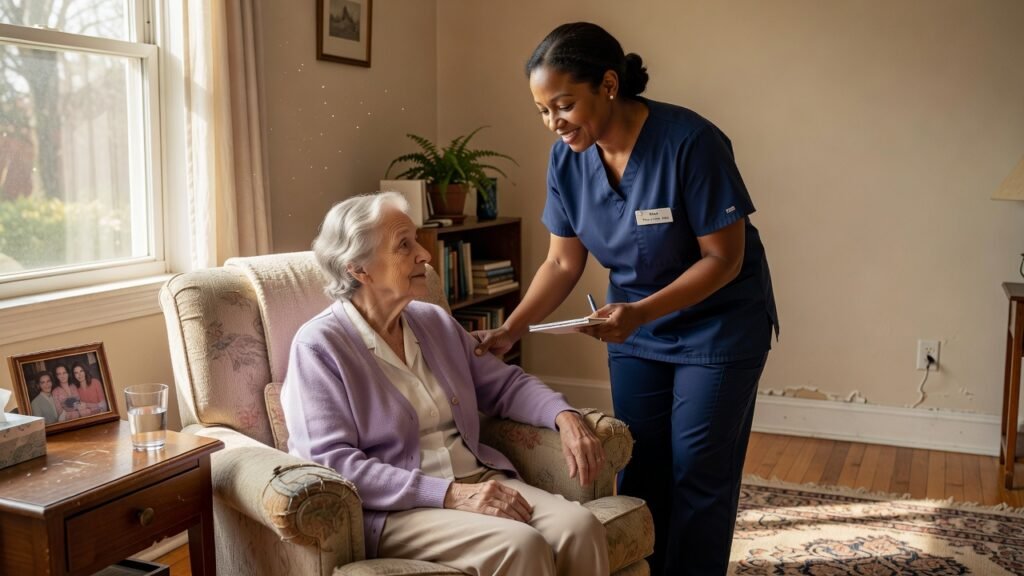
A home health aide is a trained care worker who assists an eligible person with certain daily activities in the home. Depending on the authorized service and the person’s plan of care, home care can include assistance with personal hygiene, dressing, bathing, toileting, mobility, meal preparation, and related household tasks.
An HHA is not a nurse. Home health aide services are intended for routine supportive care and do not replace skilled nursing services. The specific duties an aide may perform depend on the applicable program, training, supervision, and plan of care.
New York also has separate Personal Care Services and Consumer Directed Personal Assistance Services programs. These programs have their own eligibility and assessment requirements.
What Does Medicaid Home Care Cost?
For an eligible Medicaid member receiving an authorized Medicaid home care service, Medicaid generally pays the participating provider of managed care organization for covered services rather than charging the member the private-pay hourly rate.
That does not mean every Queens resident automatically receives free home health aide care. First, the person must qualify for Medicaid or otherwise have coverage for the applicable service. The person must also meet the program’s medical or functional eligibility requirements.
The amount of care authorized can vary substantially from one person to another. Families should therefore avoid assuming that Medicaid will automatically pay for a specific number of hours each day.
Private-pay home care is different. A family paying privately may be responsible for the agency’s full hourly rate. That rate varies by agency, service, schedule, and type of care.
Medicaid and Medicare Are Not the Same
Medicare and Medicaid can both play a role in someone’s health coverage, but they serve different purposes.
Medicare may cover certain home health services when eligibility requirements are met, including skilled services ordered through an appropriate plan of care. Medicaid can provide additional long-term services for eligible individuals through programs such as Personal Care Services, CDPAP, and other Medicaid home-care arrangements.
A person can also qualify for both Medicare and Medicaid. This is known as dual eligibility.
Rather than assuming one program will cover everything, families should ask which specific service the person needs and which program is responsible for paying for it.
How Medicaid Home Care Eligibility Works
Medicaid eligibility is not based only on income.
For home care, the person may also need to demonstrate a qualifying medical or functional need. New York has changed the assessment rules for Personal Care Services and CDPAP in recent years, so older articles can be misleading.
Step 1: Establish Medicaid Eligibility
The first step is determining whether the person qualifies for New York Medicaid.
Income and resource rules depend on factors such as age, disability status, household circumstances, and the Medicaid category involved. New York’s current Medicaid eligibility information provides different income and resource levels for different groups.
Do not rely on an old article listing one income limit for every applicant. Medicaid eligibility is more complicated than a single monthly-income number.
New York also permits some applicants to own a home, vehicle, and personal property while remaining eligible, depending on the applicable Medicaid category and circumstances.
Step 2: Complete the Required Assessment
For adults seeking Personal Care Services or CDPAP, New York implemented new minimum-needs requirements effective September 1, 2025.
Under the current rules, an individual generally must be assessed as needing at least limited assistance with physical maneuvering with more than two Activities of Daily Living. For individuals with a diagnosis of dementia or Alzheimer’s disease, the standard can be met through a specified level of supervision with more than one ADL.
These requirements are important because older online articles may describe the previous eligibility standard.
Certain people who were already receiving qualifying services or continuously enrolled in an MLTC plan before September 1, 2025, may be subject to transition rules.
Step 3: Complete the Required Clinical Process
For adults seeking Personal Care Services, New York requires a community health assessment and clinical appointment through the New York Independent Assessor program to determine eligibility.
The assessment looks at the person’s functional needs rather than simply asking whether the family wants an aide.
The result helps determine whether Medicaid-funded home care is appropriate and what level of assistance may be authorized.
What Can a Home Care Aide Help With?
Depending on the specific Medicaid program and authorized plan of care, home care services can include assistance with:
- Bathing and personal hygiene
- Dressing and grooming
- Toileting
- Mobility and transfers
- Meal preparation
- Feeding assistance
- Certain household tasks related to the person’s health and safety
- Other authorized personal care activities
New York’s Personal Care Services program specifically describes services such as housekeeping, meal preparation, bathing, toileting, and grooming.
The exact tasks depend on the program, assessment, plan of care, and applicable regulations.
What an Aide Does Not Replace
A home health aide does not replace a physician, registered nurse, or other licensed clinician.
Families should not assume that an aide can independently diagnose a medical problem, make medication decisions, administer injections, or perform skilled nursing procedures simply because the person needs those services.
The scope of an aide’s work depends on the applicable program, training, supervision, and authorization.
What About CDPAP?
New York’s Consumer Directed Personal Assistance Program allows eligible Medicaid members to choose and direct their own personal assistant.
CDPAP can allow a Medicaid member to receive care from someone they know, including certain family members. However, there are important restrictions.
Under current New York guidance, a CDPAP personal assistant cannot be the Medicaid member’s spouse, designated representative, or the parent of a CDPAP consumer under age 21.
This means the common statement that “any family member can become the paid caregiver” is incorrect.
CDPAP also has the current minimum-needs requirements that took effect September 1, 2025.
New York also transitioned to a statewide fiscal intermediary model. Current state guidance identifies Public Partnerships LLC as the statewide fiscal intermediary for CDPAP.
Common Medicaid Home Care Misconceptions
“My Family Member Earns Too Much to Qualify”
Income alone does not provide the complete answer.
New York Medicaid has different eligibility categories and rules. Some applicants may qualify under pathways that have different income or resource requirements.
The safest approach is to have the person’s circumstances reviewed under the specific Medicaid category involved rather than relying on a general income number from an older article.
“We Have Medicare, So We Don’t Need Medicaid”
Medicare and Medicaid can provide different types of coverage.
Someone who qualifies for both programs may receive Medicare for covered medical services while also receiving Medicaid-funded long-term services if they meet the applicable requirements.
“Applying Automatically Means We Will Get an Aide”
Medicaid eligibility and home care authorization are separate questions.
A person can qualify for Medicaid but still need to satisfy the applicable medical or functional requirements for home care services.
New York’s current minimum-needs requirements are particularly important for people applying for PCS or CDPAP after September 1, 2025.
“There Is Only One Medicaid Home Care Program”
There are several pathways.
Depending on the person’s circumstances, they may encounter Personal Care Services, CDPAP, home health services, Managed Long Term Care, or other Medicaid programs.
The appropriate program depends on the individual’s needs and eligibility.
“CDPAP Means My Spouse Can Automatically Be Paid”
This is not correct.
Current New York guidance specifically excludes the Medicaid member’s spouse from serving as the CDPAP personal assistant. Other family-member arrangements may be permitted subject to the program’s rules.
Applying for Medicaid in Queens
Queens residents can apply for Medicaid through NYC’s Human Resources Administration.
The NYC HRA currently lists Medicaid offices in Queens, including:
Jamaica Community Medicaid Office
165-08 88th Avenue
8th Floor
Jamaica, NY 11432
Phone: 929-252-3193
Queens Community Medicaid Office
32-20 Northern Boulevard
3rd Floor
Queens, NY 11101
Phone: 718-784-6729
Current HRA information should be checked before visiting because office procedures and locations can change.
Families can also use New York’s official Medicaid application information to determine the appropriate application route.
Documents to Prepare
The exact documents requested depend on the person’s circumstances and Medicaid category. Families may be asked for information such as:
- Proof of identity
- Proof of New York residence
- Social Security information
- Income documentation
- Information about available resources when applicable
- Immigration or citizenship documentation when applicable
- Medical or functional information relevant to the requested service
Do not assume that one document checklist applies to every Medicaid applicant.
What Happens After Services Begin?
Once home care is authorized, the person should receive information describing the services that have been approved.
Families should understand:
- What services are authorized
- How many hours or units are approved
- Which agency or plan is responsible for coordinating the service
- What the aide is authorized to do
- How reassessments work
- What to do if circumstances change
If an individual’s needs change, the family should report the change through the appropriate Medicaid plan or agency rather than simply increasing aide hours on its own.
What If Medicaid Reduces or Denies Services?
New York Medicaid members have appeal rights when covered services are denied, reduced, suspended, or terminated in circumstances covered by the state’s fair-hearing process.
Families should carefully read notices from the Medicaid plan or agency. A notice generally explains the action being taken and the available appeal process.
Because deadlines can apply, do not ignore a notice simply because the family disagrees with the decision.
Language and Cultural Needs Matter in Queens
Queens is linguistically diverse, and language can be an important consideration when arranging home care.
When speaking with a home care agency or Medicaid plan, ask whether an aide who speaks the person’s preferred language is available.
Do not assume that a specific language match is guaranteed. Availability depends on the agency, location, staffing, and the needs of the individual.
The Bottom Line for Queens Families
Medicaid can help eligible New York residents receive home-based care, but there is no single rule that determines whether someone qualifies or how many hours they will receive.
The current process involves Medicaid eligibility plus an assessment of medical and functional needs. For Personal Care Services and CDPAP, New York’s minimum-needs requirements have applied to new assessments since September 1, 2025.
If you are helping a family member in Queens, start with the official Medicaid application process and determine which home care program fits the person’s situation. Avoid relying on outdated income figures or assuming that a family caregiver is automatically eligible for payment.
For a current determination, use official New York Medicaid and NYC HRA resources or speak with a qualified Medicaid eligibility professional.
Related from Home Care Medicaid NY: Home Care Medicaid · Home Health Aide Medicaid in New York · Queens vs. Brooklyn Medicaid Home Health Aide