
🔑 Key Takeaway
Key Clinical & Policy Sources
- According to SAMHSA’s 2022 National Survey, approximately 22.8% of U.S. adults experienced mental illness in the past year.
- SAMHSA data shows only 46.2% of U.S. adults with mental illness received treatment in 2022.
- The CDC reports depression affects more than 21 million American adults annually.
Residents of Brooklyn seeking home health aide Medicaid New York can access Medicaid-covered telehealth mental health services in 2026. Our clinical team is available to help navigate enrollment, provider selection, and ongoing care coordination.
What Brooklyn Families Pay for a Home Health Aide Through Medicaid and What They Don’t
For many Brooklyn families, the cost of getting help at home can feel like the first and biggest barrier. Private-pay home care can be expensive, especially when someone needs help every day. But Medicaid can cover certain home care services for eligible New Yorkers when the person meets the program’s financial, medical, and functional requirements. The important part is understanding that Medicaid home care is not automatically approved just because someone needs help around the house. Eligibility and authorization depend on the person’s circumstances, the type of service requested, and the current New York State rules.
Compliance and Medical Disclaimer: This article is for educational purposes only and reflects New York State Medicaid and NYC Human Resources Administration guidance available in 2026. Medicaid eligibility, financial limits, assessment requirements, and covered services can change. Always confirm your individual situation with New York Medicaid, NYC HRA, or a qualified enrollment professional. Nothing in this article is legal or medical advice.
What a Home Health Aide Actually Does
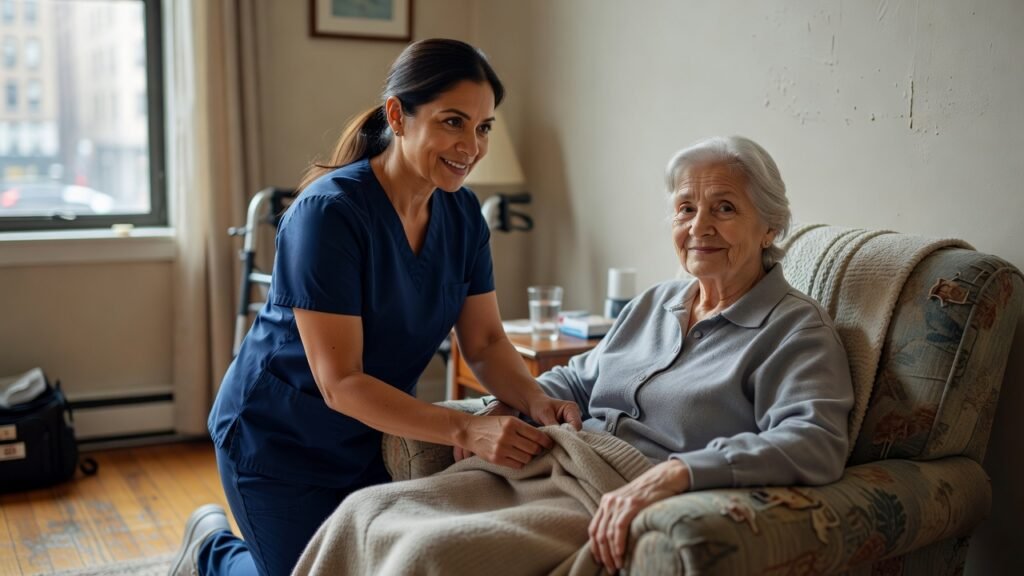
A Home Health Aide, commonly called an HHA, provides hands-on assistance with certain daily activities in the home. Depending on the authorized care plan, this can include assistance with bathing, dressing, grooming, toileting, mobility, transfers, meal preparation, and other personal care needs.
Home care is different from hiring someone simply to clean the house or provide companionship. Medicaid home care is tied to an individual’s assessed need for covered services. New York’s Personal Care Services program can include activities such as housekeeping, meal preparation, bathing, toileting, and grooming when those services are authorized under the program.
That distinction matters. A person cannot assume that Medicaid will pay for unlimited household help simply because they have Medicaid coverage.
Does Medicaid Pay the Cost of a Home Health Aide?
For people who qualify for Medicaid home care, authorized services can be covered through the Medicaid program rather than paid entirely out of pocket.
But there is an important distinction between being enrolled in Medicaid and being approved for home care services. Home care programs have their own eligibility requirements, and NYC’s Home Care Services Program states that applicants must be eligible for Medicaid.
The amount and type of care a person receives are determined through an assessment and care-planning process. Medicaid does not simply provide every applicant with a set number of aide hours.
That means families should be cautious about advertisements promising a specific number of free hours before an assessment has actually taken place.
The Major Medicaid Home Care Rule Change Families Need to Know in 2026
One of the most important changes affecting Brooklyn families took effect on September 1, 2025.
New York introduced minimum-needs requirements for people initially seeking Personal Care Services or Consumer Directed Personal Assistance Services. Under the current rules, an individual generally must be assessed as needing at least limited assistance with physical maneuvering with more than two activities of daily living.
For someone with Alzheimer’s disease or dementia, the standard is different. The person must generally be assessed as needing at least supervision with more than one activity of daily living.
These requirements apply to initial assessments and subsequent reassessments for people subject to the new criteria.
There is also an important exception. People who were already authorized for PCS or CDPAS, or who were continuously enrolled in an MLTC plan before the new rules took effect, may have Legacy Status and continue to be assessed under the previous criteria.
This is one reason families should not rely on an older article or a friend’s experience to determine whether someone qualifies today.
What Counts as an Activity of Daily Living?
Activities of daily living, or ADLs, are basic activities people perform to care for themselves.
Depending on the assessment, these can include:
- Bathing
- Dressing
- Toileting
- Eating
- Walking or transferring
- Personal hygiene
- Other essential daily activities
The important question is not simply whether someone has a medical diagnosis. The assessment looks at how that condition affects the person’s ability to function safely and independently.
Someone may have diabetes, arthritis, heart disease, Parkinson’s disease, dementia, or another chronic condition and still need to demonstrate the required functional limitations to qualify for the specific home care benefit.
How New York Determines Whether Someone Needs Home Care
The process involves more than a phone call to an agency.
New York uses an assessment process to evaluate a person’s functional needs and determine whether they meet the requirements for home care services. For people subject to the new minimum-needs rules, the New York Independent Assessor Program (NYIAP) plays an important role in the initial assessment process.
The state explains that the NYIAP assessment is the first step in determining eligibility for PCS, CDPAS, or certain MLTC enrollment. After the assessment, the individual receives information about the next steps, including whether they may qualify for MLTC or should continue with their Medicaid managed care plan for service authorization.
The assessment is not the same thing as automatically receiving a particular number of aide hours. The authorizing entity must use the assessment information to develop a person-centered service plan and plan of care that addresses the person’s health and safety needs.
What About CDPAP?
Brooklyn families should also know about the Consumer Directed Personal Assistance Program, or CDPAP.
CDPAP allows eligible Medicaid recipients to choose and direct their own personal assistant rather than having a traditional agency assign a caregiver. The consumer or their designated representative takes responsibility for recruiting, hiring, training, supervising, and terminating the personal assistant.
A personal assistant can be a friend or certain family members, although there are restrictions. For example, New York does not generally allow the Medicaid recipient’s spouse to serve as the CDPAP personal assistant, and other relationship restrictions apply.
The program can be particularly valuable for families who want more control over who provides care.
PPL Is Now the Statewide Fiscal Intermediary
Another important 2026 update is the administration of CDPAP.
Public Partnerships LLC, or PPL, is New York’s statewide fiscal intermediary for CDPAP. CDPAP recipients are required to work with PPL for the administrative and payroll functions associated with the program.
PPL handles functions such as processing personal assistant wages and benefits, payroll tax withholding, and employment records.
Who May Qualify for Medicaid Home Care?
There is no single checklist that guarantees approval, but several major factors matter.
1. You Must Meet Medicaid Eligibility Requirements
Home care through Medicaid starts with Medicaid eligibility.
For Brooklyn residents, the relevant programs are administered through New York State Medicaid and NYC HRA. Financial eligibility depends on factors such as income, household circumstances, age, disability status, and the particular Medicaid category involved.
Because financial rules can change, families should not rely on old income or asset figures published in an article from a previous year.
2. You Must Have a Qualifying Need for Home Care
Medicaid home care is intended for people who have a demonstrated need for assistance.
The current minimum-needs rules for PCS and CDPAS are particularly important for new applicants. For most adults subject to the rules, the assessment must show limited physical assistance with more than two ADLs. A different threshold applies to people with Alzheimer’s disease or dementia.
3. You Must Complete the Required Assessment Process
A medical diagnosis by itself does not guarantee home care.
The assessment considers the person’s functional abilities and care needs. The resulting information is then used in determining eligibility and developing an appropriate care plan.
4. Your Situation Must Fit the Specific Home Care Program
New York has multiple pathways for receiving care at home. Personal Care Services, CDPAS, MLTC, and other long-term care programs have different rules and eligibility requirements.
That is why two people with similar medical conditions can have different outcomes.
What Medicaid Home Care Can Cover
Depending on the program and authorization, home care may include assistance with:
| Type of assistance | May be covered? |
|---|---|
| Bathing and personal hygiene | Yes, when authorized |
| Dressing | Yes, when authorized |
| Toileting | Yes, when authorized |
| Mobility and transfers | Yes, when authorized |
| Meal preparation | Yes, when authorized |
| Certain housekeeping tasks | Yes, when part of an authorized service |
| Standalone companionship | Not automatically covered |
| Heavy household cleaning | Generally not the purpose of PCS |
| Yard work | Not a standard home care benefit |
| Skilled nursing | Separate skilled-care benefit |
The exact services depend on the person’s program, assessment, and authorized plan of care. New York’s PCS program specifically lists services such as housekeeping, meal preparation, bathing, toileting, and grooming.
Common Misconceptions Brooklyn Families Should Stop Believing
“I have Medicaid, so I automatically qualify for an aide.”
Not necessarily.
Medicaid eligibility and home care eligibility are related but not identical. A person must meet the requirements for the particular home care service being requested.
“My parent has a serious diagnosis, so Medicaid has to provide an aide.”
A diagnosis is important, but the current rules also look at functional limitations and activities of daily living.
For new PCS/CDPAS applicants subject to the post-September 2025 rules, the minimum-needs criteria must be met.
“The new rules mean everyone already receiving care loses their aide.”
Not necessarily.
People who had PCS/CDPAS authorization or continuous MLTC enrollment before September 1, 2025 may have Legacy Status and are not subject to the new minimum-needs criteria in the same way as new applicants.
“CDPAP is gone.”
No.
CDPAP remains a New York Medicaid program. The administration changed significantly, with PPL serving as the statewide fiscal intermediary.
“I can just hire an aide myself and Medicaid will reimburse me.”
That is not how ordinary Medicaid home care works.
If you are considering CDPAP, there is a specific process involving Medicaid eligibility, assessment, authorization, and the statewide fiscal intermediary.
How Brooklyn Residents Can Start the Process
If you or a family member believes you may need Medicaid home care, start with the official system rather than a private agency promising guaranteed hours.
Step 1: Confirm Medicaid Eligibility
If you are not already enrolled in Medicaid, determine whether you qualify.
NYC’s Home Care Services Program states that Medicaid eligibility is required for its home care programs.
Step 2: Contact NYC HRA
Brooklyn residents can contact the NYC Human Resources Administration for information about home care services.
HRA’s current guidance directs residents to the DSS OneNumber at 718-557-1399 for Home Care Services Program assistance.
Step 3: Complete the Required Assessment
If you meet the initial requirements, the appropriate assessment process determines whether you qualify for the requested home care service.
For people subject to the newer requirements, NYIAP is involved in the initial assessment process.
Step 4: Follow the Care-Planning and Authorization Process
If you are determined eligible, the appropriate Medicaid plan or authorizing entity develops a care plan based on your assessed needs.
The assessment does not automatically guarantee a specific number of hours.
Step 5: Consider CDPAP If It Fits Your Situation
If you want to choose and direct your own caregiver, ask whether CDPAP is appropriate for you.
Eligible CDPAP consumers are responsible for directing their personal assistants, while PPL handles the required fiscal-intermediary functions.
What Brooklyn Families Should Prepare Before Applying
Having your information organized can make the process easier.
Depending on your situation, you may need information concerning:
- Identity
- New York residency
- Income
- Financial resources
- Medicaid enrollment
- Medical conditions
- Current medications
- Doctors and other providers
- Functional limitations
- Current assistance with daily activities
- Existing home care services
- Insurance coverage
Do not assume that having one missing document automatically means you cannot qualify. Ask the appropriate Medicaid or HRA representative what documentation is required for your specific case.
The Bottom Line for Brooklyn Families in 2026
The biggest misconception about Medicaid home care is that the question is simply, “Can Medicaid pay for an aide?”
The real question is more specific: Are you financially eligible for Medicaid, do you have a qualifying need for home care, do you meet the current functional requirements, and are you applying through the correct program?
For new PCS and CDPAS applicants subject to the rules implemented September 1, 2025, the minimum-needs requirements are especially important. Existing recipients may have Legacy Status, which can change how those requirements apply to them.
If you are unsure where you fit, do not automatically assume that home care is unaffordable or that you are ineligible. Start with the official Medicaid and HRA process and get your situation evaluated.
Brooklyn residents can contact NYC HRA’s Home Care Services Program through the DSS OneNumber at 718-557-1399.
If you are considering assistance from a private enrollment service, make sure it clearly explains what it provides and does not promise Medicaid approval or a guaranteed number of aide hours.
The rules are more complicated than they were a few years ago. Getting accurate information before making a decision can save a family significant time, money, and frustration.
Related from Home Care Medicaid NY: Home Care Medicaid · Home Health Aide Medicaid in New York · Medicaid Home Care in New York